
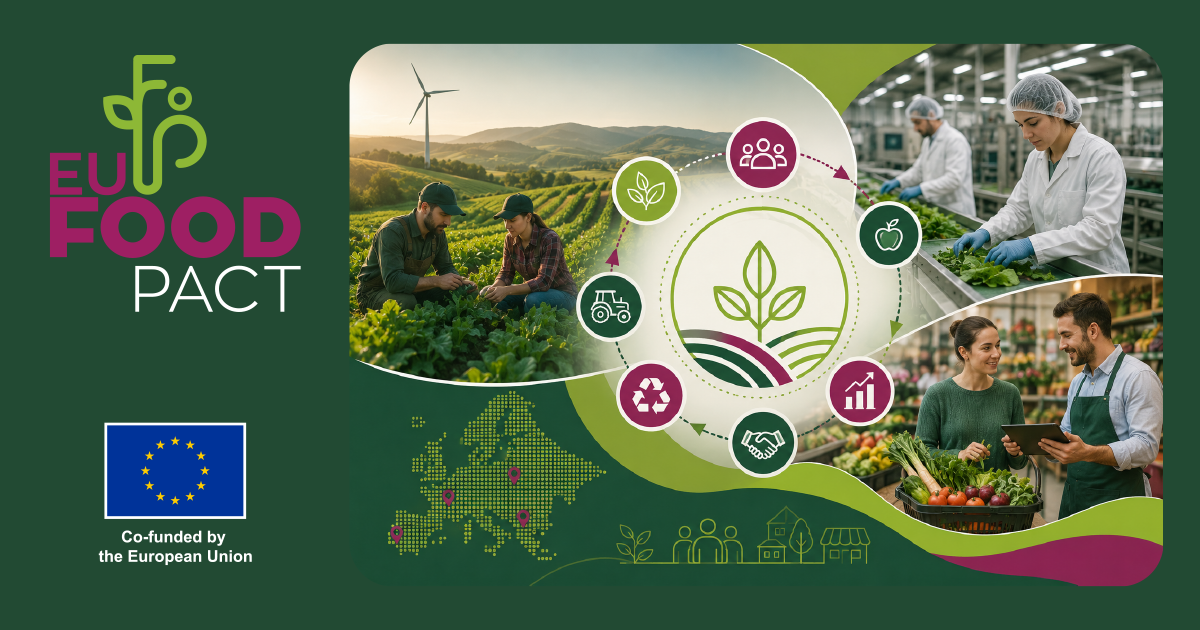
The sustainable transition of the European agri-food sector is not being held back only by regulatory ambition or by the availability of technology. There is a hidden gap: the distance between what Europe requires in terms of sustainability and what thousands of agri-food SMEs and microenterprises can actually implement in their day-to-day operations. The European Green Deal sets the course towards a climate-neutral economy, and the Farm to Fork strategy translates that course into concrete objectives for the food system, from reducing the use and risk of chemical pesticides by 50% to reaching 25% of organic agricultural land by 2030. However, practical adoption depends on human, organisational and territorial capacities that today remain insufficient.
The available evidence points to a structural problem. In the EU, only 10.2% of farm managers have received full agricultural training and 72.3% depend exclusively on practical experience; in addition, the EU FOODPACT proposal states that 44% of companies in the food and beverage sector report skills gaps in sustainability and digital innovation. In parallel, the Commission has acknowledged that three quarters of European companies, especially SMEs, have difficulties finding profiles with the right skills. Sustainability, therefore, is not only a technical or regulatory challenge: it is, above all, a challenge of applied learning, governance and support.
The European framework and the urgency of the moment
The European Green Deal defines a profound transformation: turning the EU into a modern, resource-efficient and competitive economy, with climate neutrality in 2050 and an emissions reduction of at least 55% by 2030. This framework is not accessory for the agri-food sector; it is one of its most sensitive fields of application, because it combines climate, biodiversity, energy, territorial cohesion and food security.
Within that umbrella, the Farm to Fork strategy places the sustainability of the food system at the centre of the European transition. The Commission itself recalls that agriculture accounts for 10.3% of the EU's greenhouse gas emissions, and that the strategy requires action, among other fronts, on pesticides, nutrients, organic farming, knowledge, advisory services and new skills. Specifically, the Commission set the objective of reducing by 50% the use and risk of chemical pesticides, reducing nutrient losses by at least 50% and cutting the use of fertilisers by at least 20% by 2030, in addition to aspiring for at least 25% of the EU's agricultural land to be under organic production.
Added to this transformative pressure is the CSRD, which has raised the bar for corporate sustainability reporting in Europe and, although its application and simplification have remained under political debate since 2025, is already pushing a culture of traceability, ESG data and value-chain requirements that indirectly reaches smaller suppliers. Put another way: even when an agri-food SME is not formally within the main reporting perimeter, it begins to be so de facto through commercial, financial or reputational pull. This reading is a reasonable inference from the progressive rollout of the CSRD and the recent regulatory debate on its simplification.
What is the hidden gap?
We call the hidden sustainability gap the mismatch between visible objectives (rules, certifications, metrics, digital platforms) and invisible capacities (time, skills, leadership, decision-making structures, organisational culture, support networks) that make it possible to meet them. It is not only about “not having resources”; it is about a combination of limitations that reinforce one another.
In the European agri-food sector, this gap has at least six recurring causes. The first is the scarcity of resources: many companies operate with narrow margins and reduced teams. The second is the lack of hybrid skills: it is not enough to know how to produce; sustainability, digitalisation, traceability, purchasing, energy and commercial storytelling must be integrated. The third is the weakness of governance, especially in microenterprises where almost everything falls on one or two people. The fourth is unequal access to certifications and validation schemes, which can be costly, complex or poorly adapted to small structures. The fifth is ageing and limited generational renewal, which slow down the adoption of new practices. The sixth is financing, not only to invest, but to learn, test, measure and correct.
Why technology and regulation are not enough
Europe already has a powerful combination of levers: regulation, financing, innovation and shared objectives. But the Farm to Fork text itself recognises that change requires adapted advisory services, effective AKIS systems, knowledge exchange and new skills, also for SMEs in processing, retail and catering. In other words, the Commission implicitly admits that rules without mediation do not transform by themselves.
Technology is not enough either. Traceability platforms, sensors, data tools or AI models can improve decisions, but their impact depends on the existence of processes, trust, criteria and time to use them well. Recent literature on food systems transformation insists that effective changes happen when technical innovation, social learning, multi-level governance and a systemic reading of interdependencies are combined. That is why systems thinking should not be understood as a trend, but as a practical competence: it helps to connect soil, energy, purchasing, waste, employment, training and market, preventing companies from solving one problem by creating three new ones.
This is where regenerative leadership makes sense. Compared with leadership focused only on compliance or efficiency, regenerative leadership seeks to build organisations capable of restoring ecological and social value, learning with other actors and deciding over longer horizons. In the EU FOODPACT project, this approach appears linked to systems thinking, certification and territorial collaboration, precisely because agri-food sustainability cannot be reduced to a checklist.
The value of Community Food Education Hubs and inspiring practices
The EU FOODPACT proposal for Community Food Education Hubs is relevant because it attempts to address the gap where it really exists: in the territory, in the small company and at the interface between training, market and public policy. The project plans to support at least 350 agri-food MSMEs, activate permanent learning patterns for around 600 adult people and foster the adoption of sustainability standards or certifications in at least 30 MSMEs, through an approach based on systems thinking, regenerative leadership and strategic collaboration.
Its potential value is high for three reasons. First, because it brings training closer to the real problem: energy costs, waste, purchasing, certification, commercial narrative or customer requirements. Second, because it turns sustainability into an accompanied practice, not into a download of content. And third, because it makes it possible to create “soft infrastructure”: networks between companies, chambers, training centres, administrations, certifiers and local communities. This approach fits very well with Farm to Fork's community emphasis on knowledge, exchange and advisory services.
As inspiring practices, the project cites pathways connected with certifications adapted to the context, such as CCPAE in Catalonia or Travelife in Iceland, and presents them not as ends in themselves, but as levers to organise processes, legitimise improvements and bring sustainability and market closer together. It should be underlined, however, that these references are emerging practices and do not yet amount to comparable impact evaluations at European scale.
Barriers, solutions and actionable recommendations
The following table summarises the main reading of the article: sustainability does not fail due to a lack of discourse, but due to a lack of appropriate mediations between requirement and capacity. The synthesis integrates evidence from the European framework and from the EU FOODPACT project.
Main barrier
Proposed solution
Responsible actor
Lack of time and resources in SMEs
Modular pathways, micro-credentials and in-company technical assistance
SMEs, hubs, chambers, VET centres
Deficit of green and digital skills
Training applied through real challenges and peer mentoring
Trainers, hubs, sectoral associations
Weak internal governance
Simple prioritisation tools, minimum indicators and phased roadmaps
SME management, consultants, project managers
Complexity of certifications
Pre-diagnosis, phased support and collective purchasing of certification services
Chambers, hubs, regional administrations
Ageing and insufficient generational renewal
Intergenerational programmes, distributed leadership and attraction of young talent
Administrations, agricultural organisations, educational centres
Territorial fragmentation
Community hubs connected with AKIS, local innovation and learning between territories
Public authorities and projects such as EU FOODPACT
For SMEs, the central recommendation is to start with a transition agenda in three layers: basic compliance, operational efficiency and market differentiation. For trainers, the priority is to abandon abstract training and design learning linked to everyday business decisions. For project managers, including the governance of EU FOODPACT, the key will be to measure not only how many people participate, but how much the real capacity to decide, cooperate and sustain improvements over time changes.
Open questions and priority references
Questions remain that deserve debate. How can we prevent certifications from becoming a regressive bureaucratic burden for small companies? Which minimum sustainability indicators are truly useful for an agri-food microenterprise? How can learning be financed, not only investment? And how do we ensure that the green and digital transition does not accelerate the exclusion of ageing rural territories? These questions do not weaken the sustainability agenda; they make it more serious.
Priority references
European Commission. The European Green Deal.
European Commission. A Farm to Fork Strategy for a fair, healthy and environmentally-friendly food system COM(2020) 381 final.
Corporate Sustainability Reporting Directive and subsequent simplification debate.
Kaiser, Cretella, Scherer and Lam. Transformation of food systems from systems thinking and democratic governance.
Van der Linden, Meinders, van Nes and de Vries. Methodologies for intervening in complex food systems.
European Commission and European Commissioners on skills shortages and training in European companies.